
Should You Repair Your Ductwork Before Replacing Your AC?
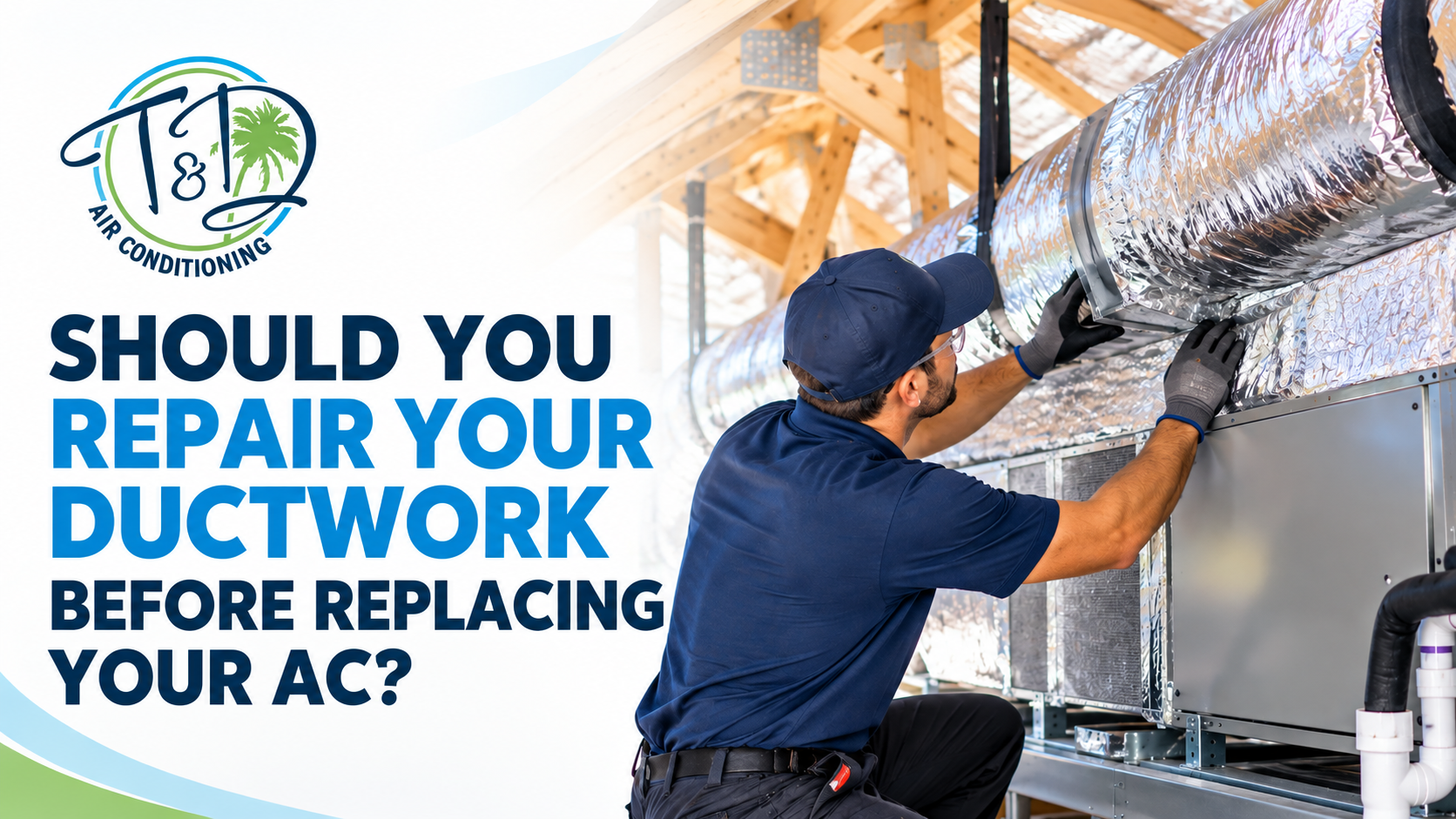
Should you repair your ductwork before replacing your AC? T & D Air Conditioning helps South Florida homeowners understand how duct leaks, poor insulation, and airflow problems can affect cooling performance and energy efficiency.
If your South Florida home has rooms that never seem to get cool enough, weak airflow from your vents, or electric bills that keep climbing, you might assume it's time for a new air conditioner.
But before investing in a replacement, there's another part of your HVAC system worth checking: your ductwork.
Your air conditioner can be working properly and still struggle to keep your home comfortable if the ducts that distribute the cooled air are leaking, poorly insulated, or restricting airflow.
For homeowners in Fort Lauderdale, Broward County, Miami-Dade County, and Palm Beach County, understanding the condition of your ductwork can help you make a more informed decision about whether to repair your existing system or invest in new equipment.
How Does Your Ductwork Affect Your AC's Performance?
Your ductwork carries conditioned air from your air handler to the rooms throughout your home. It also provides a return-air path that allows the system to circulate air properly.
When the ductwork isn't functioning as it should, your AC may have difficulty delivering the comfort you expect.
In South Florida, where air conditioners work hard for much of the year, ductwork problems can contribute to uneven temperatures, unnecessary energy use, and persistent humidity issues.
Here are four common problems worth knowing about.
1. Leaking or Disconnected Air Ducts
Small gaps, loose connections, and damaged duct sections can allow conditioned air to escape before it reaches your living spaces.
When ducts run through a hot attic or another unconditioned area, leaks can also allow unwanted heat and humid air to enter the system, depending on the location and pressure conditions.
Signs to watch for:
Certain rooms feel warmer than others.
Airflow from some vents seems unusually weak.
Your AC runs frequently without providing consistent comfort.
Your energy bills are higher than expected.
Sealing accessible duct leaks can improve air delivery and reduce energy waste. However, the extent of the improvement depends on the condition and design of the entire system.
2. Damaged or Inadequate Duct Insulation
Ducts that pass through hot attics or other unconditioned spaces need appropriate insulation.
If the insulation is damaged, compressed, or insufficient, cooled air can gain heat before it reaches your rooms. In humid Florida conditions, poorly insulated duct surfaces can also develop condensation when the surface temperature falls below the surrounding air's dew point.
Over time, condensation may contribute to moisture damage or other indoor air quality concerns.
An HVAC professional can inspect the duct insulation and recommend appropriate repairs or improvements based on your home's layout and the condition of the existing system.
3. Blocked Return Vents or Restricted Airflow
Your AC needs adequate airflow to operate properly. Supply vents deliver cooled air, while return vents allow air to flow back toward the system.
Blocked return grilles, dirty filters, crushed flexible ducts, or other restrictions can interfere with that airflow.
Possible warning signs include:
Weak airflow from multiple vents.
Rooms that take too long to cool.
Unusual airflow noise or whistling.
Ice forming on the indoor evaporator coil.
If you notice ice on your AC system, turn off cooling and arrange a professional inspection. Restricted airflow is one possible cause, but refrigerant problems and other faults can produce similar symptoms.
Keep return vents unobstructed and replace air filters according to the manufacturer's recommendations. If airflow remains poor, have the system checked rather than assuming that a new AC unit is necessary.
4. Poor Duct Design and Uneven Cooling
Sometimes, the problem isn't a leak or a damaged duct. The duct system may simply be poorly designed for the home's layout and cooling requirements.
Undersized ducts, poorly balanced airflow, inadequate return-air pathways, and unsuitable duct configurations can make it difficult to maintain consistent temperatures throughout the house.
For example, you might find that your living room stays comfortable while an upstairs bedroom or a room far from the air handler remains warm.
Before replacing your AC, ask an HVAC professional to evaluate the airflow and duct layout. If the ductwork cannot properly support the home's cooling needs, correcting those issues may be an important part of the solution.
Signs You Should Have Your Ductwork Inspected
Not every AC problem comes from the ducts. However, certain symptoms suggest that a ductwork inspection may be worthwhile, especially if your system has been struggling for some time.
Consider scheduling an evaluation if you notice:
Uneven temperatures: Some rooms are consistently warmer or cooler than others.
Weak airflow: Air coming from the vents seems weaker than usual.
Unexpectedly high electric bills: Your energy use has increased without an obvious explanation.
Persistent comfort problems: Your AC runs frequently, but certain rooms never feel comfortable.
Visible duct damage: You notice disconnected sections, damaged insulation, or crushed flexible ducts in accessible areas.
These symptoms can also result from equipment problems, poor system sizing, thermostat issues, or other conditions. A proper diagnosis helps determine what's actually happening.
Should You Repair Your Ductwork or Replace Your AC First?
The right decision depends on the condition of both your ductwork and your air conditioning equipment.
Here's a practical way to think about it.
Ductwork repair may be the better first step if:
Your AC is generally reliable and still meets your home's cooling needs.
An inspection identifies leaking connections, damaged insulation, or restricted ducts.
The equipment itself is operating properly, but air distribution is poor.
The problems can be corrected without extensive duct replacement.
AC replacement may make more sense if:
Your equipment has recurring or expensive failures.
The system can no longer reliably meet your home's cooling needs.
Replacement is more practical than continued repairs, considering the equipment's condition and expected remaining service life.
Your existing system is unsuitable for your home's current cooling requirements.
Both may need attention if: Your AC is nearing the end of its useful life and the ductwork also has significant problems.
Replacing the equipment without addressing serious ductwork issues can leave you with many of the same comfort problems. On the other hand, repairing the ducts won't solve every problem if the air conditioner itself is failing.
The goal is to identify the actual cause before committing to a major expense.
What Should You Ask Your HVAC Contractor?
If you're considering AC replacement or experiencing ongoing cooling problems, ask your contractor to evaluate the entire system rather than looking at the equipment alone.
Here are five useful questions:
Can you inspect my ductwork for leaks or damage? Ask whether accessible duct connections, insulation, and visible damage need attention.
Is my system getting adequate airflow? Airflow measurements can help identify restrictions and distribution problems.
Is my current AC properly sized for my home? Equipment sizing should account for the home's cooling load, not simply its square footage.
Can my existing ductwork support a replacement system? The ducts should be suitable for the new equipment's airflow requirements.
Which repairs are necessary, and which are optional improvements? Ask for clear explanations of the findings, recommended work, and expected benefits.
A thorough evaluation can help you compare your options and understand where your money is likely to make the biggest difference.
Make an Informed Decision Before Replacing Your AC
When your home isn't cooling properly, replacing the air conditioner might seem like the simplest solution. But your ductwork plays an important role in how effectively that cooled air reaches every room.
Leaking ducts, inadequate insulation, restricted airflow, and poor duct design can all contribute to comfort problems. Identifying and correcting these issues may improve your existing system's performance or help ensure that a replacement system works as intended.
Before making a major investment, consider having both your air conditioner and ductwork evaluated. Understanding the condition of the entire system puts you in a better position to choose the right solution for your home.
Need Help With Your Home's Cooling Problems?
At T & D Air Conditioning, we help South Florida homeowners understand their HVAC concerns and explore practical solutions for better home comfort.
Whether you're dealing with uneven cooling, weak airflow, or considering an AC replacement, our team can help you determine the next steps for your system.
Call 954-922-7010 to discuss your home's cooling needs.
