
AC Sizing Guide: Why Bigger Isn’t Always Better for Florida Homes
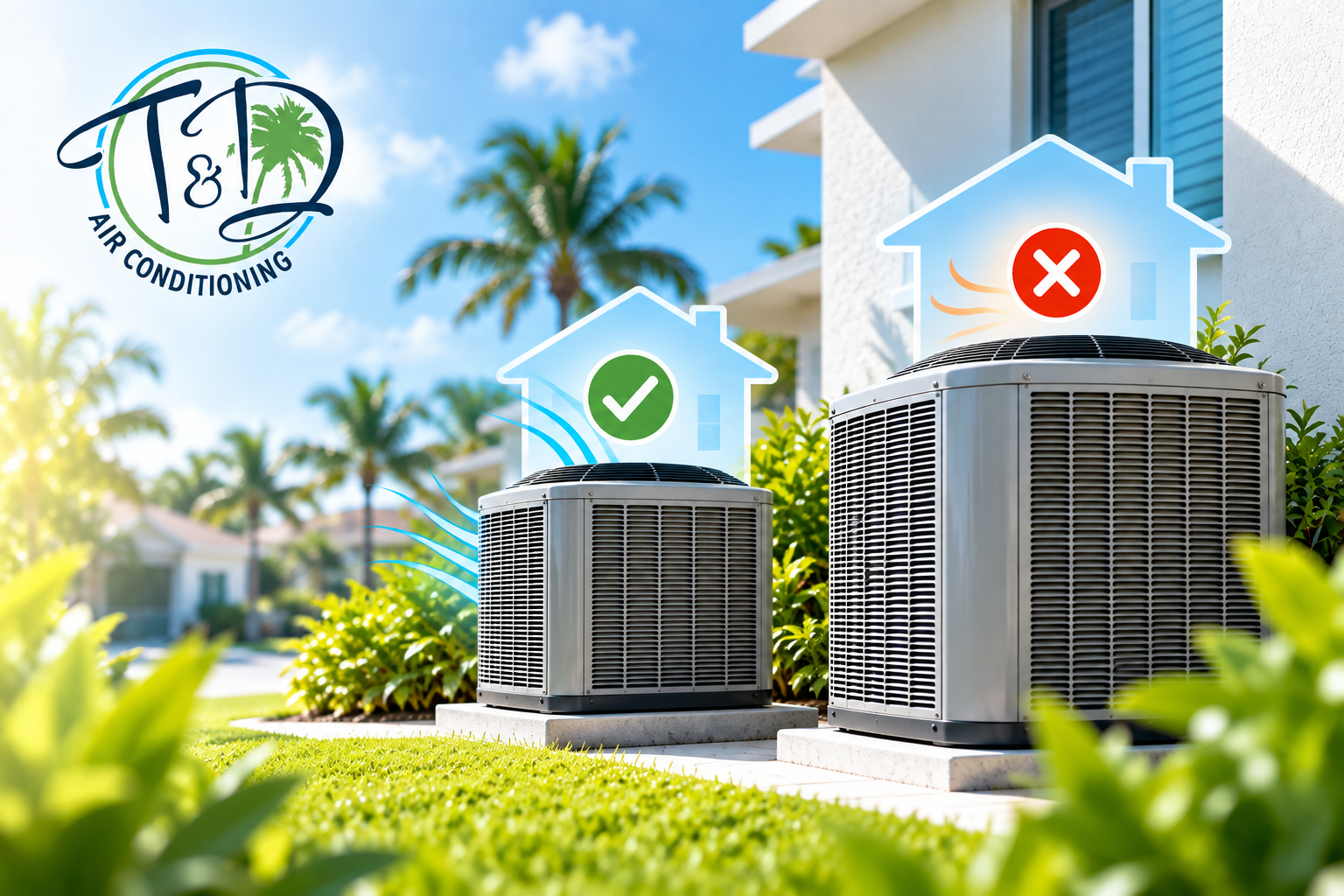
Why bigger isn’t always better for Florida homes. Proper AC sizing helps improve comfort, humidity control, and energy efficiency in South Florida. Learn how the right AC size can make a difference before replacing your system.
If you're replacing an air conditioner in South Florida, you might assume that a larger AC unit will cool your home faster and keep your family more comfortable.
It sounds logical—but bigger isn't always better when it comes to air conditioning.
An oversized air conditioner can cool a home too quickly without running long enough to properly remove moisture from the air. That can lead to uncomfortable humidity, frequent cycling, uneven temperatures, and potentially higher operating costs.
For Florida homeowners, choosing the proper AC size is about more than square footage. Your home's layout, insulation, windows, ceiling height, sun exposure, ductwork, and local climate all play a role.
Here's what South Florida homeowners should know about AC sizing before replacing their system.
What Does AC Sizing Mean?
When HVAC professionals talk about AC sizing, they're referring to how much cooling capacity an air conditioner needs to adequately cool a home.
Air conditioning capacity is commonly measured in tons. One ton of cooling capacity represents approximately 12,000 BTUs of cooling per hour.
That doesn't mean a 2,000-square-foot home automatically needs a particular number of tons.
The correct size depends on the home's actual cooling requirements.
Professional HVAC contractors can use a cooling load calculation to determine how much cooling your home needs. For residential applications, one commonly used method is ACCA Manual J, which considers characteristics of the home rather than relying solely on a square-footage rule of thumb.
According to the U.S. Department of Energy, accurate heating and cooling load calculations are important for properly sizing HVAC equipment. Using simple rules of thumb can result in oversized systems that cost more and may operate less efficiently.
Why Bigger Isn't Always Better
An oversized air conditioner may seem like a good idea because it has more cooling capacity.
The problem is that your AC doesn't just need to lower the temperature—it also needs to remove moisture from the air.
An oversized system can reach the thermostat's temperature setting quickly and shut off before it has had enough time to adequately dehumidify the home.
This is known as short cycling.
Instead of running through longer, efficient cooling cycles, the system repeatedly turns on and off.
That can contribute to:
Poor humidity control
A clammy or sticky feeling indoors
Uneven temperatures throughout the home
More frequent starts and stops
Increased wear on system components
Reduced comfort
Potentially higher energy use
ENERGY STAR similarly recommends properly sized air conditioning equipment because oversized systems can cycle too frequently and provide poorer humidity control.
Why Humidity Matters So Much in South Florida
Humidity is one of the biggest reasons AC sizing matters in South Florida.
Unlike drier parts of the country, homes throughout Broward, Miami-Dade, and Palm Beach counties regularly deal with high outdoor humidity.
Your air conditioner performs two important jobs:
It removes heat from your home.
It removes moisture from the air.
When an AC system is properly sized, it can run long enough to accomplish both.
But when a system is significantly oversized, it may satisfy the thermostat too quickly. The temperature may look perfect on the thermostat while the home still feels humid.
That can be especially noticeable in bedrooms, bathrooms, closets, and other areas where moisture tends to accumulate.
For Florida homeowners, temperature isn't the only measurement of comfort. Humidity matters too.
What Determines the Right AC Size?
A professional AC sizing evaluation should consider much more than the square footage of your home.
Some of the factors that can affect your home's cooling load include:
Home Size and Layout
The overall square footage matters, but so does the way that space is arranged.
An open-concept home may behave differently from a home with multiple enclosed rooms.
Ceiling Height
A home with 10- or 12-foot ceilings has considerably more air volume than a home with standard 8-foot ceilings.
That can affect the cooling requirements.
Windows and Doors
The size, orientation, number, and efficiency of your windows can influence how much heat enters the home.
Large windows facing direct afternoon sun can add a significant cooling load.
Insulation
Proper insulation helps slow the transfer of heat into your home.
If insulation is inadequate, an AC system may have to work harder to maintain the desired indoor temperature.
Shade and Sun Exposure
Trees, neighboring buildings, roof design, and the orientation of your home can all affect how much solar heat enters the house.
A heavily shaded home may have different cooling requirements from an otherwise identical home exposed to direct sunlight.
Ductwork
Your duct system is another important part of the equation.
Leaky, poorly insulated, or improperly sized ducts can affect how efficiently conditioned air reaches the rooms in your home.
Installing a new AC without considering the ductwork may leave you with an expensive system that still doesn't perform as expected.
Home Improvements
Renovations can change your home's cooling requirements.
Adding rooms, replacing windows, improving insulation, converting a garage, or changing the home's layout can all affect the amount of cooling capacity you need.
How Do You Know If Your AC Might Be Oversized?
You can't determine whether an AC is oversized simply by looking at the equipment's tonnage.
However, certain symptoms may justify having your system evaluated.
Possible signs include:
Your AC turns on and off frequently.
Your home feels humid even when the thermostat reaches the set temperature.
Some rooms feel comfortable while others remain uncomfortable.
The system cools the house extremely quickly and shuts off.
You notice frequent cycling throughout the day.
Your indoor temperature is comfortable, but the home still feels damp or clammy.
These symptoms don't automatically mean your AC is oversized. Refrigerant problems, airflow restrictions, duct issues, thermostat problems, insulation, and other HVAC issues can cause similar symptoms.
A professional evaluation can help determine what's actually happening.
What If Your AC Is Too Small?
Oversizing isn't the only problem.
An air conditioner that is too small may struggle to keep up with the home's cooling demand, particularly during South Florida's hottest weather.
You might notice:
The AC runs for very long periods.
The home struggles to reach the thermostat setting.
Certain rooms remain warmer than others.
The system appears to run constantly during hot afternoons.
Energy costs increase without the expected comfort.
Again, these symptoms don't necessarily mean the equipment is undersized. Poor airflow, duct leaks, low refrigerant, insulation problems, or other issues can produce similar results.
That's why proper diagnosis matters before replacing equipment.
Don't Choose an AC Based on Square Footage Alone
One of the most common AC sizing mistakes is using a simple formula such as:
"My house is X square feet, so I need X tons of AC."
Square footage can provide a starting point, but it shouldn't be the only factor used to select equipment.
Two homes with the same square footage can have very different cooling requirements.
For example, consider two 2,000-square-foot South Florida homes:
One has new energy-efficient windows, upgraded insulation, shaded walls, and efficient ductwork.
The other has older windows, high ceilings, significant afternoon sun exposure, and aging ductwork.
Those homes may require different amounts of cooling capacity.
The right AC size should be based on the home—not simply the size of the home.
What About SEER2?
When shopping for a new air conditioner, you'll probably hear about SEER2.
SEER2 is an efficiency rating used to describe the seasonal energy performance of cooling equipment.
A higher efficiency rating can potentially reduce energy consumption compared with a less efficient system, depending on how the equipment is used and other factors.
But it's important to understand the difference:
AC sizing determines how much cooling capacity your home needs.
SEER2 helps describe how efficiently the equipment operates.
A high-efficiency air conditioner that is improperly sized isn't necessarily going to deliver the comfort you're expecting.
The goal is to select equipment that is properly sized, properly installed, and appropriately matched to your home.
What Should You Ask an HVAC Contractor?
If you're replacing your AC, don't be afraid to ask questions.
A reputable HVAC professional should be able to explain:
How they determined the recommended AC size
Whether a cooling load calculation was performed
Why a particular system capacity was recommended
Whether your existing ductwork is appropriate
How your home's insulation and windows affect the load
What efficiency rating the proposed system has
Whether the equipment is properly matched
What installation improvements may be necessary
If the only explanation you're given is "Your neighbor has this size, so you need the same thing," it's worth asking for more information.
Your home is unique, and your HVAC system should be selected accordingly.
Replacing Your AC? Start With the Home, Not the Equipment
Replacing an air conditioner isn't simply about choosing the biggest or most powerful system available.
A properly designed HVAC replacement should consider the entire home.
That means looking at the cooling load, ductwork, insulation, airflow, thermostat, equipment efficiency, and installation requirements.
For South Florida homeowners, it also means considering our long cooling season and high humidity.
The right system should provide consistent cooling, better humidity control, efficient operation, and dependable comfort without being unnecessarily oversized.
And if your existing system is still working but you're unsure whether it's properly sized, an HVAC professional can evaluate its performance before you commit to replacement.
Need Help Choosing the Right AC for Your South Florida Home?
Whether you're replacing an aging air conditioner, building an addition, or simply wondering whether your current system is properly sized, getting professional advice can help you avoid an expensive sizing mistake.
At T & D Air Conditioning, we help homeowners throughout South Florida evaluate their cooling needs and find HVAC solutions that make sense for their homes.
From Fort Lauderdale and Broward County to Miami-Dade and Palm Beach County, our team can help you determine whether your system needs repair, maintenance, or replacement.
Don't guess when it comes to AC sizing. Get the right system for your home.
Ready to schedule service?
Book your HVAC service online with T & D Air Conditioning and let our team help you find the right solution for your home.
