
Where Should Your AC Air Handler Be Installed: Attic, Garage, or Closet?
Where should your AC air handler be installed? Compare attic, garage, and indoor closet options to find the right setup for your Florida home.
When it comes to keeping your South Florida home comfortable, your air conditioner gets most of the attention. But there's another important part of your HVAC system that homeowners shouldn't overlook: the air handler.
Depending on your home's design, your air handler may be installed in the attic, garage, or a dedicated indoor closet. Each location has advantages and potential drawbacks, especially in Florida's hot, humid climate.
So, which location is best for your home?
The answer depends on several factors, including available space, drainage, insulation, ductwork layout, and access for maintenance. Understanding these differences can help you make a more informed decision when installing a new HVAC system or replacing existing equipment.
What Does an AC Air Handler Do?
An air handler is the indoor component of a central air conditioning system. It typically contains a blower that circulates air and an evaporator coil that removes heat from indoor air as refrigerant passes through it.
As warm air moves across the evaporator coil, the system cools it and removes some of its moisture. The blower then distributes the conditioned air throughout your home through the ductwork.
Because the air handler handles airflow and condensation, its installation location must accommodate proper drainage, electrical connections, ductwork, and access for servicing.
1. Installing an Air Handler in the Attic
In many South Florida homes, the attic provides a convenient location for HVAC equipment without taking up valuable indoor space.
Advantages of an attic installation
Saves indoor space: Keeps the equipment out of closets, garages, and living areas.
Convenient duct routing: Can work well when most of the home's ductwork runs through the attic.
Keeps the garage available: Leaves more room for vehicles, storage, and other uses.
Potential disadvantages
Extreme temperatures: Attics can become very hot, increasing heat gain through inadequately insulated ducts and making the installation environment more demanding.
Drainage concerns: A clogged condensate line or overflowing drain pan can cause water damage to ceilings and surrounding materials.
Limited maintenance access: Tight openings, cramped spaces, or inadequate walkways can make inspections and repairs more difficult.
Insulation requirements: Properly insulated ducts and sealed connections help limit unwanted heat gain and condensation.
Is an attic installation right for your home?
An attic can be a practical option when there is safe access, adequate structural support, appropriate drainage, and sufficient room for servicing the equipment.
In Florida, condensate management deserves particular attention. Depending on the installation, secondary drain protection or other safeguards may be required to reduce the risk of water damage.
2. Installing an Air Handler in the Garage
A garage can be a convenient location for an air handler, especially in homes designed with a dedicated mechanical area.
Advantages of a garage installation
Convenient service access: Technicians may be able to reach the equipment without entering an attic.
Potentially easier maintenance: A suitable garage layout can provide more working room for inspections and repairs.
Keeps equipment outside living spaces: Avoids using a hallway or bedroom closet for the air handler.
Potential disadvantages
Heat and humidity exposure: Garages can become hot and humid, so appropriate insulation, sealed duct connections, and installation practices are important.
Space limitations: The equipment must have adequate clearance for servicing without obstructing vehicle access or other required clearances.
Ductwork considerations: Poorly designed or sealed duct connections can contribute to energy loss and uneven cooling.
Applicable safety requirements: The installation must meet relevant building, mechanical, electrical, and manufacturer requirements.
Is a garage installation right for your home?
A garage can be a good choice when there is enough room for the equipment, maintenance access is convenient, and the ductwork can be routed effectively.
Your HVAC contractor should also evaluate the garage's temperature and humidity conditions and confirm that the proposed installation meets applicable code requirements.
3. Installing an Air Handler in an Indoor Closet
Some homes have a dedicated HVAC closet in a hallway, laundry area, or another convenient indoor location.
Advantages of a closet installation
Convenient access: The equipment can often be reached without entering an attic or moving items in a garage.
Less exposure to extreme temperatures: An indoor location generally experiences less temperature variation than an attic or garage.
Convenient routine maintenance: Accessible equipment can make inspections and troubleshooting easier.
Efficient use of other areas: Keeps the garage available for vehicles and storage while avoiding attic access.
Potential disadvantages
Uses indoor space: The closet occupies space that could otherwise be used for storage.
Airflow requirements: The closet must provide the proper return-air arrangement and clearances specified for the equipment.
Noise considerations: Blower operation and airflow sounds may be more noticeable near bedrooms or living areas.
Water damage risks: A condensate leak can damage flooring, walls, or nearby belongings if drainage and protective measures are inadequate.
Is an indoor closet installation right for your home?
An indoor closet can be an excellent option when the equipment fits properly and there is sufficient room for airflow, drainage, and maintenance.
However, the closet should not be treated as ordinary storage space. Blocking return-air grilles or crowding the equipment can interfere with performance and make servicing more difficult.
Attic vs. Garage vs. Closet: Which Is Best?
There is no universally best location for every home. The right choice depends on your home's design, the existing ductwork, available space, and the quality of the installation.
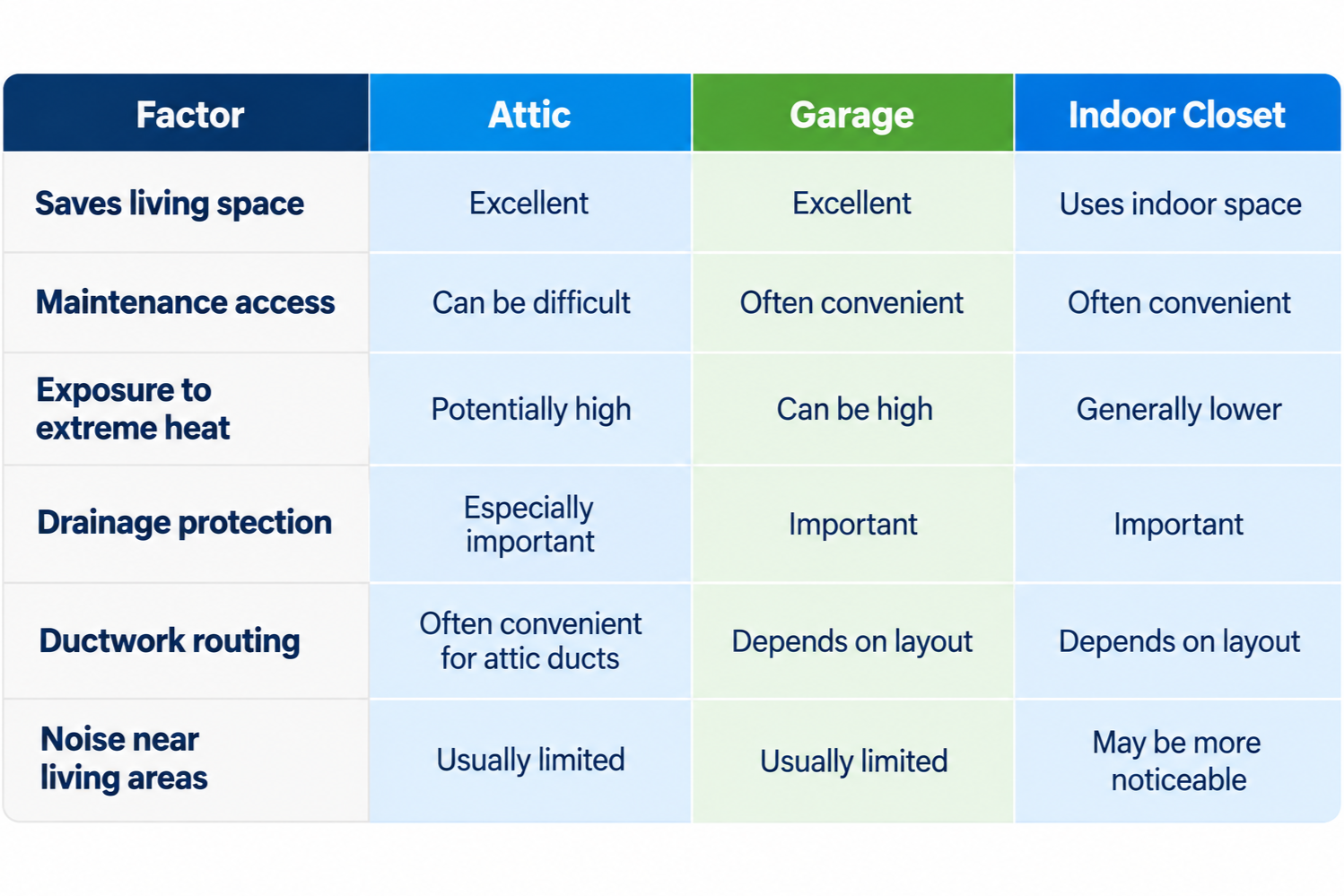
These are general comparisons, not guarantees. A well-designed installation in any of these locations can perform reliably, while poor installation practices can create problems regardless of location.
5 Things to Consider Before Choosing an Installation Location
Before installing or relocating an air handler, make sure your HVAC contractor evaluates these five important factors.
1. Maintenance Access
Technicians need enough space to inspect, clean, and repair the equipment safely. Difficult access can complicate routine maintenance and increase the time needed for certain repairs.
Ask whether the proposed location provides the access and working clearances required by the manufacturer and applicable codes.
2. Condensate Drainage and Water Protection
Air conditioning removes moisture from indoor air, producing condensate that must drain away properly.
A blocked drain line can cause water to overflow from the drain pan. Depending on the equipment's location, this can damage ceilings, walls, flooring, and stored belongings.
Ask your contractor how the installation will handle primary drainage, overflow protection, and access for clearing the drain line. Specific requirements depend on the installation and applicable Florida codes.
3. Insulation and Humidity Control
South Florida's hot, humid climate makes insulation and moisture management especially important.
Attic and garage installations may be exposed to higher temperatures than indoor closets. Proper duct insulation, sealed connections, and suitable installation practices help limit unwanted heat gain and condensation.
Your contractor should also confirm that the system is appropriately sized and configured to meet your home's cooling and humidity-control needs.
4. Ductwork Layout and Airflow
The air handler must work effectively with your home's supply and return ductwork.
A location that requires unnecessarily long, restrictive, or difficult-to-seal duct connections may create installation challenges. Your contractor should evaluate duct sizing, airflow, return-air pathways, and the overall system design before recommending a location.
5. Building Codes and Manufacturer Requirements
Air handler installations must meet applicable requirements for structural support, electrical connections, drainage, access, and other safety considerations.
Florida building codes and local requirements may vary according to the property and installation. A qualified HVAC contractor can determine which requirements apply and whether permits are needed.
Should You Relocate Your Existing Air Handler?
If your current air handler is difficult to access, has recurring drainage problems, or occupies space you'd rather use for something else, relocating it might be worth discussing.
However, moving an air handler isn't always the most cost-effective solution. The work may involve changes to ductwork, refrigerant lines, electrical connections, drainage, equipment supports, and other components.
Before deciding, ask your contractor to compare the cost and practical benefits of relocating the equipment with the cost of addressing the problems at its current location.
If your system is functioning properly and the installation meets applicable requirements, improving access or correcting drainage and insulation issues may be sufficient.
Final Thoughts: The Right Installation Matters More Than the Location Alone
An attic, garage, or indoor closet can all be suitable locations for an AC air handler when the installation is properly designed and maintained.
The most important considerations are safe access, effective drainage, suitable insulation, proper airflow, and compliance with applicable requirements. In South Florida, moisture management and heat exposure deserve particular attention.
Whether you're building a home, replacing an existing HVAC system, or considering relocating your air handler, evaluating these factors before work begins can help you make a more informed decision.
Need Help With Your Home's HVAC System?
At T & D Air Conditioning, we help South Florida homeowners understand their air conditioning needs and explore practical solutions for reliable home comfort.
If you're considering an AC replacement, experiencing recurring HVAC problems, or want to discuss your air handler's installation, our team is here to help.
